
Ukraine says Elon Musk's Starshield service partially restored after restrictions disrupted drone missions
The Ukrainian military can again use SpaceX’s Starshield satellite service on the move, a Defense Ministry source told Recorded Future News on Thursday, days after sudden restrictions disrupted drone missions along the front line.
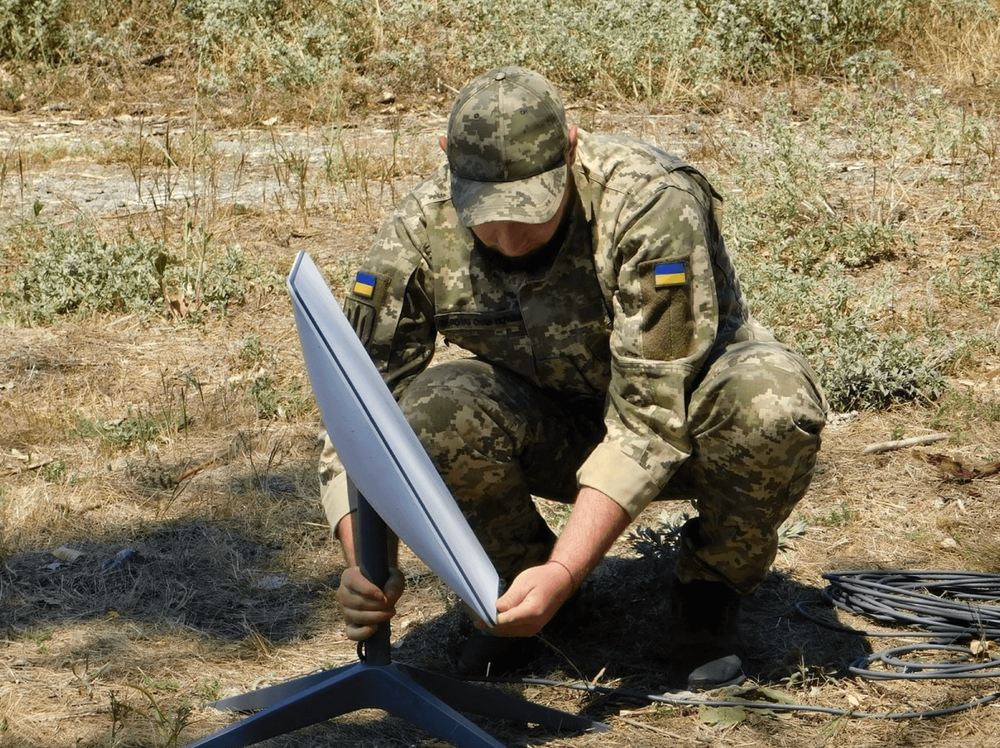
Starshield, a military-grade version of SpaceX’s Starlink internet service, keeps Ukrainian units connected through terminals mounted on vehicles and drones as they travel.
Overnight Tuesday, without warning, that connection was disrupted as new restrictions limited how fast a terminal could move and still hold a connection — forcing troops to cancel combat missions and complicating drone operations, logistics and reconnaissance.
“Starshield connectivity while in motion has now been restored and remains operational,” the source said, citing reports from military units and speaking anonymously because they were not authorized to speak publicly.
The ministry told Recorded Future News on Wednesday that connections had improved at speeds of up to 160 kilometers per hour (about 100 mph), though the formal speed limit remained in place.
The cause of the restrictions remains unclear. Officials are in talks with SpaceX and its partners to find out, the source said.
Musk points to Washington
Responding Wednesday to former Ukrainian Defense Minister Mykhailo Fedorov, who called for the speed limits to be lifted entirely, Musk said the U.S. government controlled Starshield and was responsible for deciding how the service could be used.
"Starshield systems are owned and controlled by the US government. Any limits on speed or usage are decided by the US military and ultimately POTUS," Musk wrote on X.
Fedorov said removing Starshield’s speed limit was critical for Ukraine's defense and expressed hope that Musk would continue supporting the country.
Musk, however, drew a distinction between Starshield and SpaceX's commercial Starlink service, saying the latter was intended for civilian or defensive purposes and could not be used for offensive military operations.
The comments appeared to shift responsibility for the restrictions toward Washington, although officials in President Donald Trump's administration have reportedly denied involvement.
Administration officials told Axios that the U.S. government did not control SpaceX and had not ordered the restrictions. Washington nevertheless planned to contact the company to determine what caused the disruptions.
Drone missions disrupted
The restrictions have already had consequences on the battlefield, particularly for Ukrainian drones that depend on satellite connectivity for navigation and control.
Ukraine's 7th Air Assault Corps said units operating in the Huliaipole sector in southern Ukraine began reporting communication problems overnight Tuesday as the new limits took effect.
According to the military, some drones experienced connection losses lasting between 10 and 20 seconds while traveling at speeds of just 110 to 120 kilometers per hour — well below the formally established threshold.
Although the drones continued flying, the interruptions made them harder to control. Slowing them down to maintain connectivity also increased their vulnerability to Russian attacks.
The problem was particularly severe for medium-range strike drones, which require relatively high speeds during takeoff.
Under the new conditions, unstable communications could make it impossible to launch some drones or use them for their intended missions, the military said.
At least one drone unit operating in the Huliaipole sector was forced to cancel some missions because of connectivity problems.
Serhii Beskrestnov, a Ukrainian military technology expert and presidential adviser, said the restrictions also threatened Ukraine's ability to intercept Russian drones.
He said Starlink was essential to interceptor drones used against high-speed, jet-powered Shahed drones, warning that the restrictions could deprive Ukraine of one of its few effective defenses against those weapons.
“Our defense forces received no advance warning of the restriction, which caused several missions to fail. Clearly, this move cannot be a coincidence and is linked to the current political situation,” he added but didn’t provide further details.
Zelensky blames Trump
The Starlink disruption comes amid worsening relations between Kyiv and Washington, following disputes over Ukrainian strikes against Russian oil infrastructure and the Trump administration's decision to pursue a diesel trade agreement with Moscow.
In an interview with Piers Morgan this week, Zelensky said he felt personally betrayed by Trump over the restrictions, accusing Washington of abandoning a crucial partner more than four years into Russia's full-scale invasion.
The Ukrainian president alleged that both SpaceX and the United States were responsible for the disruption, which he said would cost Ukrainian lives.
"I am sure they knew what they did, absolutely," Zelensky said, adding that the restrictions would result in further casualties.
The Kremlin, meanwhile, said it had no official information confirming the reported restrictions. Kremlin spokesperson Dmitry Peskov added that Moscow would prefer technologies such as Starlink not to be used for military purposes in the war.
A critical technology for Ukraine
Starlink has played a central role in Ukraine's military communications since the beginning of Russia's full-scale invasion in 2022, when Musk activated the service following an appeal from Fedorov.
SpaceX subsequently provided thousands of terminals, helping Ukraine restore communications damaged by Russian attacks.
But Musk's relationship with Kyiv has become increasingly complicated. He has previously raised concerns about the costs of providing the service and the risks of its use in offensive military operations. In a separate statement yesterday, he even suggested that “it’s time for Zelensky to go.”
In March 2025, however, Musk pledged never to disconnect Ukraine from Starlink, acknowledging the Ukrainian military's dependence on the technology.
Earlier this year, SpaceX also took steps to prevent unauthorized Russian use of Starlink after Ukrainian officials reported that Russian forces were installing the terminals on attack drones. Ukraine also introduced a verification system that allows only registered Starlink devices to operate in Ukrainian-controlled territory.
Suspected sabotage
The latest restrictions come as Starlink-related infrastructure supporting Ukraine has also faced suspected sabotage in Europe.
In September, a fire damaged electrical equipment at a Starlink ground station in Poland. Polish authorities investigated possible sabotage, with prosecutors saying they had grounds to suspect the perpetrators could have acted on behalf of Russian intelligence services.
Earlier this week, two masked men deliberately set fire to 11 of 17 Starlink antennas at a facility near Bulgaria's capital, Sofia, according to local authorities. The antennas were used by Ukraine and other customers.
There is no publicly confirmed evidence linking the two incidents or establishing Russian involvement in the Bulgarian attack.



Daryna Antoniuk
is a reporter for Recorded Future News based in Ukraine. She writes about cybersecurity startups, cyberattacks in Eastern Europe and the state of the cyberwar between Ukraine and Russia. She previously was a tech reporter for Forbes Ukraine. Her work has also been published at Sifted, The Kyiv Independent and The Kyiv Post.